Catalog ads
Catalog ads (DPA) for retargeting vs prospecting
Convinci team. Published 2026-09-26, updated 2026-09-26.

Catalog ads (also called dynamic product ads, or DPA) started as a retargeting tool. You looked at a pair of shoes, and the shoes followed you. Today Meta also uses them to find new buyers. Meta calls that reaching a broad audience.
The two jobs need different settings. This page puts Meta's advice for each side by side. It comes from Meta's pages on retargeting and broad audiences.
The difference in one table
| Retargeting | Prospecting | |
|---|---|---|
| Who sees it | People who viewed or carted a product | People who have not visited or bought |
| What they see | The products they looked at, or similar ones | Products Meta thinks they will like |
| Audience setting | A catalog custom audience | Location and basic demographics |
| Exclude | Recent buyers | Buyers from the last 10 days |
| Creative job | Remind and give a reason to buy now | Introduce your brand |
Meta's page on Advantage+ catalog ads lists both as uses. It also lists cross selling and upselling.
How to set up retargeting
Meta's retargeting page gives four tips.
Use a catalog custom audience. Include people who viewed or added products to their cart. Exclude people who bought recently.
Split by time. Someone who viewed a product yesterday is warmer than someone who viewed it 14 days ago. Meta suggests an ad set for each time window, with different bids.
Widen the window if you are small. Meta suggests a retention window of 30 or 90 days to grow the audience.
Cross sell after a purchase. Show related products to people who just bought.
Retargeting depends on your pixel. If your product IDs do not match your catalog, Meta cannot tell who viewed what. Our catalog ads not converting checklist covers the pixel checks.
How to set up prospecting
Meta's broad audience page gives different advice.
Keep targeting simple. Use location and demographics. Meta says to avoid "too many behavioral and interest-based criteria," since they may limit reach.
Exclude only recent buyers. Meta recommends excluding people who bought in the last 10 days.
Do not exclude all site visitors. This one surprises people. Meta says including some visitors "helps your ads reach people likely to find them relevant."
Optimize for conversions. Meta names purchase, add to cart and complete registration as standard events to optimize for.
The creative is different too
This is the part most stores skip. A retargeting shopper already knows your store. A prospecting shopper does not.
Meta's broad audience page says to choose creative "relevant to new customers." For carousel ads, it suggests an intro card to introduce your brand.
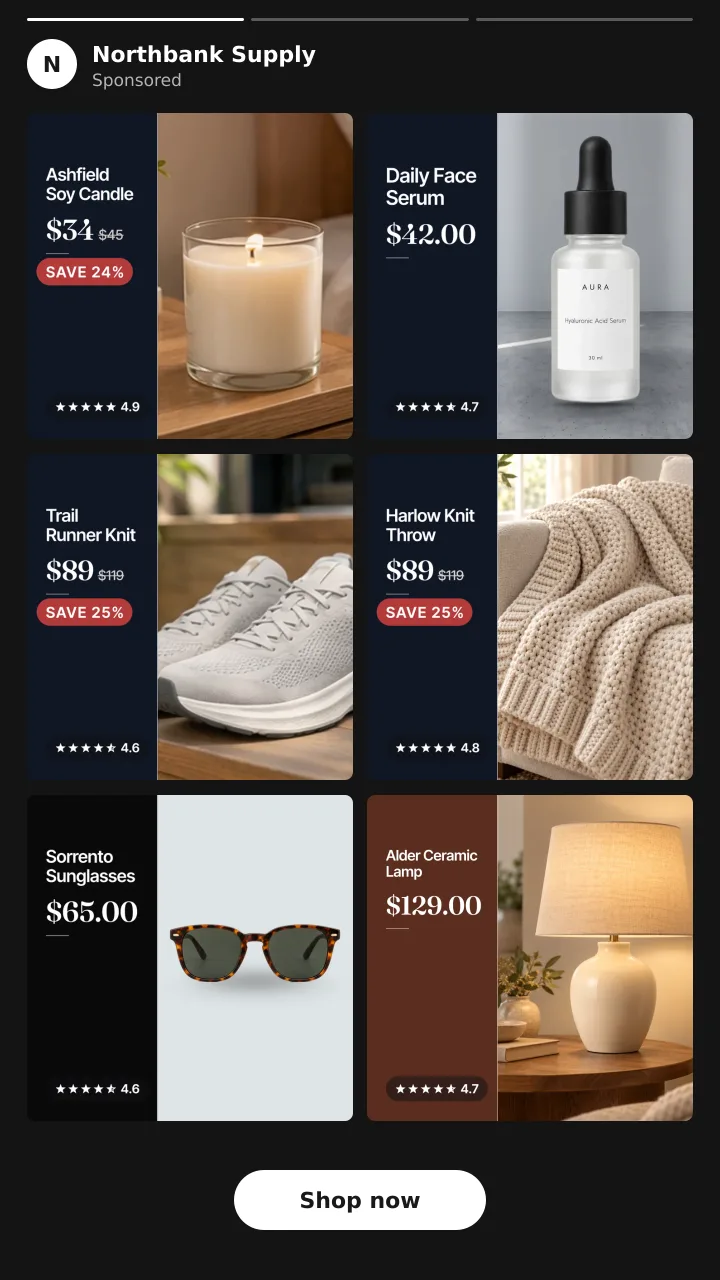
A plain white product photo says nothing about who you are. For a new shopper, your name, your price and your reviews on the card do the introducing. Here is a sunglasses card from the Northbank Supply sample store.

The rating, price and badge are sample data. For retargeting, the same layout gives a warm shopper a reason to come back today, like a true sale.
Meta's catalog ads show the image from your catalog, so the card is the same wherever the ad runs. To use a designed image without editing your ads, add it through a supplementary feed. Read how to make catalog ads look better for the steps.
Product sets for each
Your product set shapes each campaign too.
- Retargeting works well with All products. Meta shows people the items they looked at, so a narrow set can hide those items.
- Prospecting also benefits from a broad set. Meta says "a broader set may improve ad performance." You may still leave out cheap add ons that no new buyer starts with.
Our guide to product sets for catalog ads shows how to build them.
Which one should a small store run first
If your store gets steady traffic, start with retargeting. The audience is warm and the pixel already knows what they viewed.
If traffic is low, a retargeting audience may be too small to spend. A broad audience gives Meta more people to work with. Many stores end up running both, in separate ad sets, so each gets its own budget.
Whichever you run, make the cards worth stopping for. See your own products as branded cards in the free preview. Plans are on the pricing section.
Questions
- What is the difference between retargeting and prospecting catalog ads?
- Retargeting shows people products they viewed or carted but did not buy. Prospecting shows your products to a broad audience that has not visited or bought yet.
- Can catalog ads reach new customers?
- Yes. Meta's broad audience option shows products to people who have shown interest in products like yours, even if they never visited your website or app.
- Who should I exclude from catalog ads?
- For retargeting, Meta suggests excluding people who bought recently. For prospecting, it suggests excluding buyers from the last 10 days, but not all of your site visitors.
- How long should my retargeting window be?
- Meta suggests extending your catalog custom audience to 30 or 90 days to grow its size. You can also split it into time windows with different bids.
- Should retargeting and prospecting use different images?
- Meta suggests creative that is relevant to new customers for prospecting. A card that shows your brand, price and reviews helps both groups, since it introduces and reminds at once.
See these badges on your own products before you pay anything.
Try the free previewFree for 10 products. See pricing.